IBC 1000 L accessories


 Heating jackets


 Fittings
 Drums, jerrycans & fittings
 Seeds
 Plant protection & biocides

 Garden


 Green spaces & municipal

 Barbecue, fire pit & fireplace
 Cleaning & care
 Refrigerants & air conditioning

 Watering


Sulphur treatment in the garden: which diseases it works on, and what precautions to take
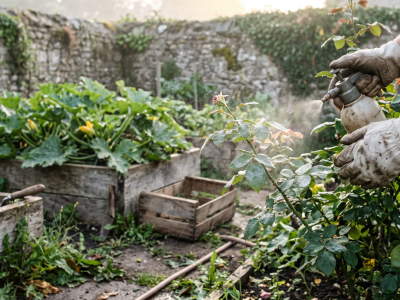
One morning in June, you walk past the rose bush and the leaves have taken on a white veil, as if someone had dusted them with flour. Three days earlier, there was nothing. It is powdery mildew, and sulphur is one of the oldest remedies used against it: it has been sprayed in vineyards and gardens since long before synthetic fungicides. Yet it remains poorly understood. People confuse it with bicarbonate, spread it in full sun and are surprised when the leaves burn. Here is what it really does, what it is used for, and what is worth knowing before you take out the sprayer.
🍃 SULPHUR IN THE GARDEN: WHAT IT IS AND HOW IT WORKS
Sulphur is a fungicide: it stops microscopic fungi from settling on leaves, stems and fruit. It works in two ways. By contact, it leaves a thin layer on the leaf that the fungus tolerates badly. By vapour, it spreads around the plant and also protects the nooks the spray has not reached. That is why it is mainly asked to prevent: it gives its best results when it is in place before the disease has taken hold.
It is one of the fungicides allowed in organic farming, which does not mean without precautions, as we will see below. And it is above all a product to use with discernment: it only works against certain diseases, not all of them.
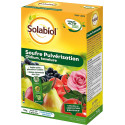
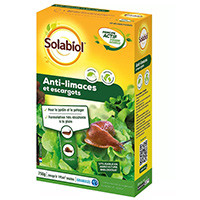
The SOLABIOL sulphur spray 750 g that we offer is a treatment of this kind. On the box, it targets powdery mildew, scab and black spot, with both preventive and curative action; it comes as concentrated micro-granules that dissolve instantly in water, for up to 100 litres of preparation, and it is stated to be usable in organic farming. If you are hesitating between several treatments, our garden disease control range brings them all together.
🔬 WHICH DISEASES IS SULPHUR USED AGAINST?
Before treating, you need to recognise the enemy. The same gesture, sulphur on every leaf that looks sick, is worthless against a disease that is not its own. Here are the five that are most often confused.
| Disease | How to recognise it | Does sulphur help? |
|---|---|---|
| Powdery mildew | A white, powdery down that rubs off with a finger, on leaves, young shoots, sometimes fruit | Yes, it is its main use |
| Rose black spot | Brown-black spots with a fringed edge on the leaves, which turn yellow and then fall | Yes, especially as prevention |
| Scab | Brown or olive-green spots on the leaves and fruit of apple and pear trees | Yes, it is one of the diseases the product targets |
| Downy mildew | Yellow spots on top and a greyish felt underneath, on tomato, potato or vine | No: this is the domain of Bordeaux mixture |
| Peach leaf curl | Blistered, reddish leaves in spring | No, it is not the reference treatment |
Peach leaf curl often comes up in searches related to sulphur. It is treated above all at the end of winter, before the buds swell, with a product designed for it, such as this peach leaf curl treatment. Once the leaves have curled, it is too late for those ones: you protect the next ones.
📅 WHEN TO TREAT, AND WHEN TO HOLD BACK
Fungi thrive on mild, damp weather: spring and a rainy autumn are the risk seasons. If your roses or apple trees were already hit last year, treating before the symptoms is far more effective than chasing the disease.
As soon as you see the first white down, do not let it drag on. First remove the badly affected leaves, then treat. A leaf that is already white will not turn green again: the aim is to protect the ones that are growing.
In full sun, in great heat, or just before rain. Sulphur can burn foliage in very hot weather, and rain washes it off before it has done its job. The label states the temperature limit not to exceed: it is the label that rules.
The right window is early morning or late afternoon, with no wind. No wind so that the product lands on the plant and not on you. And in the evening if possible when the plant is in flower, because the bees have finished foraging.
🧪 PREPARING AND APPLYING WITHOUT MISTAKES
One remark first: you will find here neither a dose in grams per litre nor a pre-harvest interval. These figures depend on the product, the crop and the regulations of the moment. They are on the label of the sachet, and that is the one to follow, not a blog article.
For a rose bush, two or three shrubs, a small pre-pressure sprayer is quite enough. For an orchard or a hedge of roses, look instead at the larger models in the sprayers category.
⚠️ IS SULPHUR DANGEROUS? THE PRECAUTIONS
“Natural” does not mean “risk-free”. Sulphur as a powder or in granules irritates the eyes and throat when breathed in, and the mixture can sting sensitive skin. So you need to equip yourself, even for a single rose bush:
The European rule comes down to two sentences, and it applies to all products of this kind: “Use plant protection products safely. Always read the label and product information before use.”
🆚 SULPHUR, BICARBONATE OR BORDEAUX MIXTURE: WHICH TO CHOOSE?
One search comes up often: “sulphur bicarbonate”. This product does not exist. These are two separate treatments, with different active substances, confused because both are put in the “anti-mildew” box. Add Bordeaux mixture, and here is how to find your way.
| Product | Active substance | Rather against | Worth knowing |
|---|---|---|---|
| Sulphur | Sulphur | Powdery mildew, black spot, scab | Can burn in great heat; some crops tolerate it badly |
| Potassium bicarbonate anti-mildew | Potassium hydrogen carbonate | Powdery mildew, scab, grey mould | Works by contact: both sides of the leaves must be thoroughly wetted |
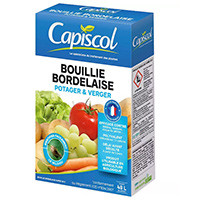
| Bordeaux mixture | Copper | Downy mildew, scab, peach leaf curl | Can leave bluish marks on the foliage |
None of the three does everything. The gardeners who manage best alternate them according to the disease and the season, rather than always repeating the same one. If you want to understand the third on the list, our guide to organic Bordeaux mixture compares the formats and brands.
🌹 ROSES, FRUIT TREES, VEGETABLE GARDEN: PRACTICAL CASES
Roses. Powdery mildew and black spot are their two great enemies. Pick up fallen leaves in autumn, they keep the disease over the winter, and leave air between the stems when pruning. A rose bush fed too much nitrogen makes tender shoots that attract fungi: our guide to fertiliser for roses helps with dosing, and the complete rose kit brings together soil, fertiliser and treatment.
Fruit trees. For scab on apple and pear trees, prevention starts with gathering dead leaves and pruning so the crown is aired. The treatment, sulphur or Bordeaux mixture, is applied in spring, when damp conditions favour the disease.
The vegetable garden. Courgettes, cucumbers and melons readily catch powdery mildew, but plants of this family are also known to be sensitive to sulphur. Try it on a few leaves first, or turn to bicarbonate. If you are planning next season, our guide to sowing courgettes, cucumbers and melons also explains how to give the plants air.
Multitanks Expert Tip
Note on the calendar the date of each treatment and what the weather was like. Two seasons later, you will know at what time of year your rose bush or apple tree gives way, and you will treat just before rather than just after. It is the gesture that changes the most, and it costs nothing.
🔎 Which treatment for which symptom?
Choose what you see on the plant
Share this content