



 Accessoires IBC 1000 litres
 Couvertures Chauffantes
 Raccords Plomberie
 Bidons / Futs et raccords
 Semences
 Produits Phyto


 Jardin


 Espaces Verts
 Barbecue - Braséro - Cheminée
 Entretien
 Fluides & Climatisation
 Arrosage
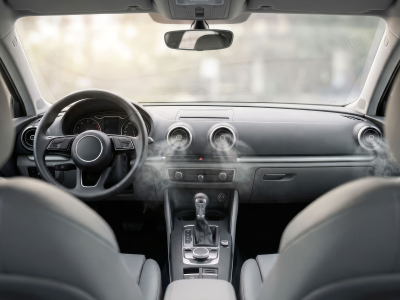
Why my car AC smells bad: causes and solutions
You get into your car on a hot day, you turn on the air conditioning — and a stale, even distinctly musty smell fills the cabin. This often happens after a period of non-use, or at the first start of the season. Good news: this smell has a well-identified cause, and simple, lasting solutions exist. You just need to understand what is really happening under the dashboard — and distinguish the harmless smell from the sign of a more serious problem.
❄️ THE EVAPORATOR, THE NUMBER ONE CAUSE OF BAD ODOUR
The main cause of a bad air conditioning smell is the proliferation of mould and bacteria on the evaporator, a component located under the dashboard that cools the air before it enters the cabin. Its operation creates, by nature, an environment conducive to their development.
To understand the mechanism, you need to grasp what the evaporator does: it circulates a refrigerant gas at very low temperature through a network of metal fins. The warm outside air passing through these fins cools abruptly, and the moisture it contains condenses into droplets — exactly like the outside of a glass of cold drink on a hot day. Normally, this condensation water drains away through a small pipe visible under the vehicle. You have certainly already noticed that harmless puddle of water under your car in hot weather: that is the drain in action.
The problem arises when the engine is switched off. The evaporator no longer cools, but remains warm and damp for several hours. In this warm, moisture-saturated environment, moulds belonging to the genera Cladosporium, Aspergillus and Penicillium, as well as various bacteria, find ideal conditions to colonise the fins and ducts. In extreme cases, Legionella have even been identified in this type of environment. This development is slow and silent: it generally takes two to three years before the colony is developed enough to produce a perceptible smell as soon as the air conditioning is switched on.
❄️ THE CABIN AIR FILTER, THE SECONDARY CAUSE TOO OFTEN OVERLOOKED
The cabin air filter — often called the pollen filter — is a secondary cause of odour that is frequently neglected, even though it directly affects the durability of the solution. This filter, generally accessible behind the glove box or under the bonnet depending on the model, continuously receives dust, pollen, diesel particles, spores and even small insects present in the air. Over the months, it gradually becomes saturated.
Once clogged, this filter presents two problems: on the one hand, it no longer filters the air properly; on the other hand, the organic matter it retains in a confined space itself becomes a breeding ground for moisture and mould. This is why disinfecting the evaporator without simultaneously replacing the filter only solves the problem temporarily: the secondary source persists, and the smell returns a few weeks later. Professional sources specialising in automotive maintenance indicate that the combination of both interventions — evaporator disinfection and cabin air filter replacement — eliminates approximately 95% of odour problems. A figure that illustrates well why one without the other remains a half-solution.
There is also a simpler mechanical cause to address: the condensate drain pipe can become blocked over time (dead leaves, limescale deposits, mud). When this drain is obstructed, the water produced by condensation stagnates in the collection tray and considerably accelerates the proliferation of micro-organisms. Unblocking it with a flexible wire or a blast of compressed air is generally sufficient to resolve the problem.
❄️ HOW TO IDENTIFY THE TYPE OF SMELL BEFORE ACTING?
Not all bad air conditioning smells have the same cause, and confusing a mould problem with a gas leak or an electrical fault can lead to ineffective or dangerous interventions. Precisely identifying the nature of the smell is therefore the first step before any action.
| Type of smell detected | Probable cause | Recommended action |
|---|---|---|
| Musty, stale, damp | Mould on the evaporator and/or saturated cabin air filter | Evaporator disinfection + filter replacement |
| Burning, hot plastic | Blower motor overheating or defective electrical component | Electrical inspection by a professional |
| Chemical, ether, solvent | Possible refrigerant gas leak in the sealed circuit | Dedicated diagnosis (leak detector, UV tracer) |
| Stale tobacco, animals, food | Organic residue trapped in the cabin air filter | Cabin air filter replacement |
The burning smell is the one that should raise the alarm most quickly: it does not come from the air conditioning circuit in the strict sense, but from an electromechanical component under stress — a worn blower motor, a defective heating resistor — and requires an inspection by a professional without delay. The chemical smell, meanwhile, especially if the air conditioning is cooling less well than before, should raise suspicion of a leak in the refrigerant gas circuit: this is an entirely different type of problem, which has nothing to do with moisture or mould and requires specific refrigeration tools to be diagnosed correctly.
❄️ WHAT IS THE HEALTH RISK?
A musty smell in the cabin is not just unpleasant — it can have a real impact on the health of the occupants, particularly during repeated daily journeys. The colonies of mould and bacteria established on the evaporator release spores and mycotoxins into the air which are then blown directly into the cabin by the ventilation.
For the majority of healthy people, occasional exposure remains without serious consequence. On the other hand, people suffering from allergies, asthma or respiratory sensitivity may experience airway irritation, sneezing, or a worsening of their symptoms. This is a concrete reason not to ignore a persistent smell that has lasted for several weeks: it is not an aesthetic problem, it is an indoor air quality problem.
❄️ PRACTICAL SOLUTIONS TO ELIMINATE THE SMELL PERMANENTLY
To permanently eliminate bad air conditioning smells, you need to act simultaneously on the two main sources: the evaporator and the cabin air filter, while adopting a simple preventive habit at the end of each journey. Here are the steps to follow in logical order.
For duct disinfection, the Errecom Interior Purifier purifying treatment is a product suited to this use: it is sprayed into the cabin, then the ventilation is activated to diffuse the product throughout all the ventilation ducts. Its purifying action eliminates contaminants and sanitises the air as well as the surfaces of the ventilation system. Its strawberry fragrance also makes it a pleasant treatment to use. According to the product data sheet, it can be used as a one-off treatment before the summer season, or as regular maintenance every 7 to 10 days. It is available in the Automotive parts and supplies range from Multitanks.
The Errecom Interior Purifier purifying treatment (strawberry fragrance) is designed to eliminate contaminants and purify the cabin air as well as surfaces, including ventilation systems. Simple instructions: spray then activate the ventilation for diffusion throughout all ducts.
The combination of evaporator disinfection + cabin air filter replacement resolves approximately 95% of odour problems. Treating one without the other only solves the problem temporarily: the persistent secondary source causes a rapid recurrence.
The most effective habit is also the simplest and least costly: turn off the air conditioning 2 to 3 minutes before stopping the engine, while maintaining the ventilation. The evaporator dries out and the conditions for micro-organism proliferation disappear before they even get established.
❄️ CHEMICAL SMELL: A PROBLEM OF AN ENTIRELY DIFFERENT NATURE
When the smell detected is chemical in nature — somewhat like ether, solvent or a particular gas — and the air conditioning is cooling noticeably less well than before, you should not conclude that it is a mould problem. This type of smell, associated with a loss of cooling efficiency, should raise suspicion of a leak in the refrigerant gas circuit.
This circuit is an entirely sealed system — compressor, condenser, evaporator, pressurised pipes — which has nothing to do with the ventilation ducts or the cabin air filter. A leak in this circuit cannot be fixed with cleaning or a disinfectant. It requires a precise diagnosis carried out with specific refrigeration tools — an electronic leak detector or UV tracer — in order to locate the leak before any intervention. Confusing the two types of problems leads to wasting time and money on the wrong intervention, with no result.
❄️ Multitanks expert tip: the free habit that makes all the difference
The most effective preventive habit against bad air conditioning smells costs absolutely nothing: turn off the air conditioning (not the engine) two to three minutes before reaching your destination, while maintaining — or even increasing — the ventilation speed. The warm air then circulating over the fins dries the evaporator in a few minutes, removing the moisture needed for mould to develop. Practised on every journey, this habit prevents the problem from appearing in the vast majority of cases. Better to prevent than to disinfect — and this tip is within everyone's reach, starting today.
Share this content