



 IBC 1000 L accessories
 Heating jackets
 Fittings

 Drums, jerrycans & fittings
 Seeds
Seeds 





 Plant protection & biocides


 Garden



 Green spaces & municipal
 Barbecue, fire pit & fireplace
 Cleaning & care
 Refrigerants & air conditioning


 Watering
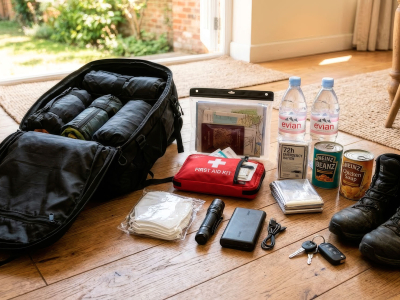
Wildfire: the emergency kit to prepare before it gets close
The question is no longer really about probability: with the increasing frequency and intensity of wildfires observed every summer across much of French territory, the real question has become "am I ready if it happens near me". This article does not explain how to fight a fire — that is the role of firefighters and no one else — but how to prepare a calm and rapid evacuation, on the order of the authorities, thanks to a kit prepared in advance, calmly, before the situation demands it.
🔥 WHY THE 72-HOUR KIT EXISTS AND WHAT IT ACTUALLY DOES
The 72-hour emergency kit is an official device recommended by French Civil Security for all major risks, including wildfires: its objective is to allow you to manage three days in complete autonomy and to leave your home in five minutes flat if the evacuation order comes. It is neither a wilderness survival kit nor firefighting equipment. It is a rapid departure tool, nothing more — and this framing is fundamental.
This point must be stressed, because the temptation sometimes exists to want to "defend one's home" against an approaching wildfire. This idea can cost lives. A fire front in strong heat and wind can move at unexpected speeds, and the hot gases ahead of the visible fire are themselves lethal well before the flames arrive. Civil Security is unambiguous on this point: when the evacuation order is given, you leave. The kit serves exactly that purpose: making this departure possible without hesitation or a frantic dash through the house.
Concretely, the bag must be stored in a location known to every member of the household, ideally on the ground floor if you live in a house, so that it is accessible within seconds without crossing the entire home. In an apartment building, the same principle applies, with one absolute additional rule: in the event of evacuation, never use the lifts. Every family member — including children old enough to understand — must know where this bag is and what it contains.
🔥 WHAT A TRULY COMPLETE 72-HOUR EMERGENCY KIT CONTAINS
The contents of the 72-hour kit are the subject of converging recommendations from several independent sources, notably Civil Security and the prefectures of exposed departments. The common base remains the same regardless of the risk: documents, water, food, communication, first aid and physical protection. For a wildfire in particular, certain items take on increased importance, first and foremost respiratory protection against smoke, which often precedes the flames by several minutes.
Here are the items listed in this official base, to be adapted according to your household's composition:
Respiratory protection deserves particular attention in the context of a wildfire. The smoke from a vegetation fire contains fine particles and toxic gases that can cause severe irritation of the respiratory tract, even at a distance from the fire front. Slipping several FFP2 masks into the kit — one per household member, plus a reserve — is a simple, low-cost precaution officially recommended by the French civil security authorities for evacuations in smoky environments.
🔥 THE SPECIFIC NEEDS THAT MAKE ALL THE DIFFERENCE
Every household has its own specific needs, and anticipating them in the kit is precisely what distinguishes a calm evacuation from a chaotic one. For a baby, you need to include infant formula or breast milk substitute with the appropriate water, nappies and enough spare clothing for 72 hours. A baby cannot wait for an open pharmacy in the middle of a crisis: everything must be in the bag, right now.
For an elderly person or someone with a disability, anticipation is even more decisive. Hearing aid batteries, equipment specific to mobility or health needs, and above all a summary sheet of current treatments — to be handed easily to a doctor or emergency services — must find their place in the kit. Also consider notifying or pre-registering these individuals with the local council as part of summer monitoring schemes, so that they are not overlooked during a neighbourhood evacuation.
Pets represent another variable to factor in. Crisis management studies regularly show that refusing to leave without one's pet is one of the causes of delays during emergency evacuations. Preparing 72 hours' worth of food in advance, along with their health record and a carrier bag, avoids searching for all of this in an emergency. Also find out in advance about the gathering points in your area that accept animals: not all community halls are prepared for this.
Defining an outdoor meeting point and a reference contact outside the risk zone in advance is just as important as the kit itself. In the event of a separate evacuation (children at school, partners at work), every family member must know where to meet the others without needing to make calls that overload the network.
FR-Alert is the French State alert system that sends a warning message directly to mobile phones of people present in a danger zone, without prior registration. Enabling receipt of these alerts and keeping your phone battery charged (using the power bank in the kit) is the best way to avoid being caught off guard.
Identifying two evacuation routes from your home in advance — avoiding roads that run alongside forested areas — allows you to make the right decision in a matter of seconds. GPS works even without a mobile network for navigation, but a paper road map of the area remains an additional security measure.
🔥 THE RIGHT REFLEXES ON THE DAY DANGER DRAWS CLOSE
The behaviour to adopt when the situation deteriorates is described very precisely by the official Civil Security doctrine, and it is worth knowing before the day comes. The absolute rule is as follows: you only evacuate on the order of the authorities — FR-Alert notification, door-to-door by law enforcement, loudspeakers — or, if you are fortunate enough to be informed early enough, you can leave voluntarily and calmly well before the situation becomes critical. What is excluded, however, is deciding to improvise a panicked flight in the face of a visible fire front: roads crowded with fleeing vehicles are dangerous and block emergency services.
If you spot the start of a fire, the first reflex is to alert the emergency services via 999 (emergency services) or 112 (European emergency number), specifying the location of the fire as precisely as possible, an estimate of its size and, if you can observe it safely from a secure location, the wind direction. Deaf or hard-of-hearing individuals can use SMS emergency services. Every useful piece of information passed on to the emergency services can speed up the response. After alerting, favour SMS over phone calls: they get through on more congested networks and free up voice bandwidth for professional emergency teams.
Two behaviours are formally prohibited and deserve to be cited explicitly. The first is going to "watch the fire" out of curiosity: every bystander on forest roads physically delays fire engines and rescue vehicles. The second is flying a recreational drone near a forest fire. This action, which may seem harmless, grounds water-bombing aircraft and helicopters for as long as the airspace is not secured — it is a criminal offence, and it can directly cost lives. Finally, always think of your vulnerable neighbours: an elderly or isolated person who has not seen the alerts can be warned in a matter of seconds, and this simple gesture can make a real difference.
To stay informed in real time, rely only on official channels: the FR-Alert app, verified accounts of your department's prefecture on social media, and national and regional general news outlets. Avoid relying on rumours or witness posts on social media, which can be contradictory or simply inaccurate. If in doubt about what to do, the prefecture's single number or the emergency services can also guide you.
🔥 KIT MAINTENANCE: AN ANNUAL CHECK WORTH ITS WEIGHT IN GOLD
A kit prepared once, left unchecked for three or four years, is a false sense of security: expired medications do not heal, flat batteries do not power the radio, and a document pouch that has not been updated since a house move is useless. Civil Security recommends checking the kit contents once a year, ideally before the summer season, even before the main holiday departures.
This annual check takes no more than thirty minutes if done methodically. It involves checking the expiry dates of food and medications, testing the torch and radio batteries, making sure documents are up to date (new passport, change of address on insurance policies, new prescriptions), and replacing clothing if children have grown or if seasonal needs have changed. It is also a good time to recharge the power bank and test all the equipment. This annual review can be combined with other seasonal preparations, such as checking your water reserve or inspecting the mandatory brush clearance around your property, which is itself an official prevention measure.
💡 The Multitanks tip: prepare calmly, leave serenely
A kit prepared on a quiet evening, without urgency, methodically ticking off each item, is infinitely better than improvising under the grip of panic. The sole objective of this preparation is to save you the precious minutes that truly count on the day: no searching for keys, no uncertainty about where the passport is, no question of "did I pack grandmother's medication". You grab the bag, take your family, and leave on the order of the authorities, in an orderly and calm manner. That is what being prepared means. Also consult our articles on water reserves in the face of fire risk and on green spaces and brush clearance to complete your preventive approach.
Share this content