IBC 1000 L accessories
 Heating jackets
 Fittings
 Drums, jerrycans & fittings
 Seeds

 Plant protection & biocides

 Garden


 Green spaces & municipal


 Barbecue, fire pit & fireplace
 Cleaning & care
 Refrigerants & air conditioning
 Watering
- New
- Pack
World's Fastest Online Shopping Destination
Instead of €29.20
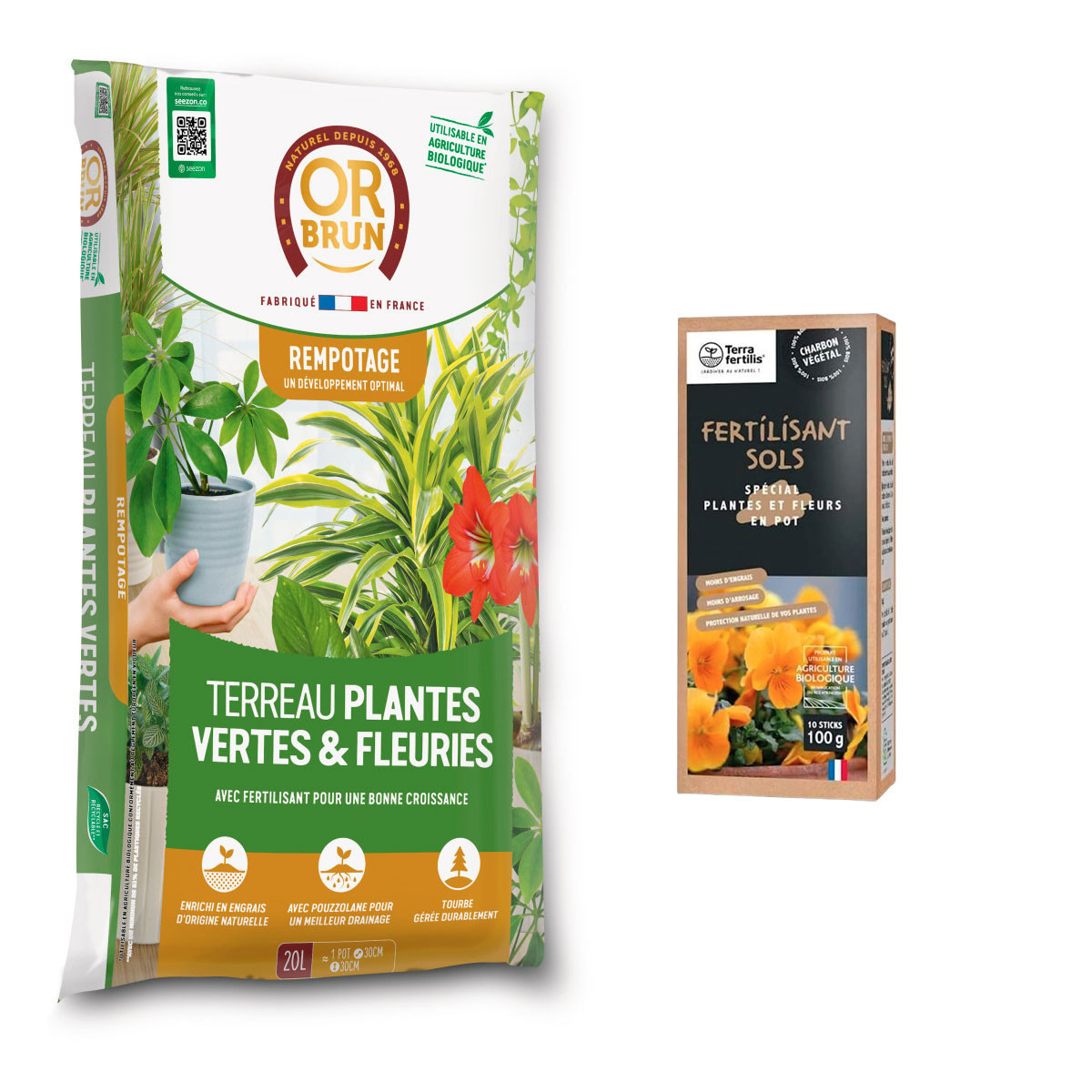
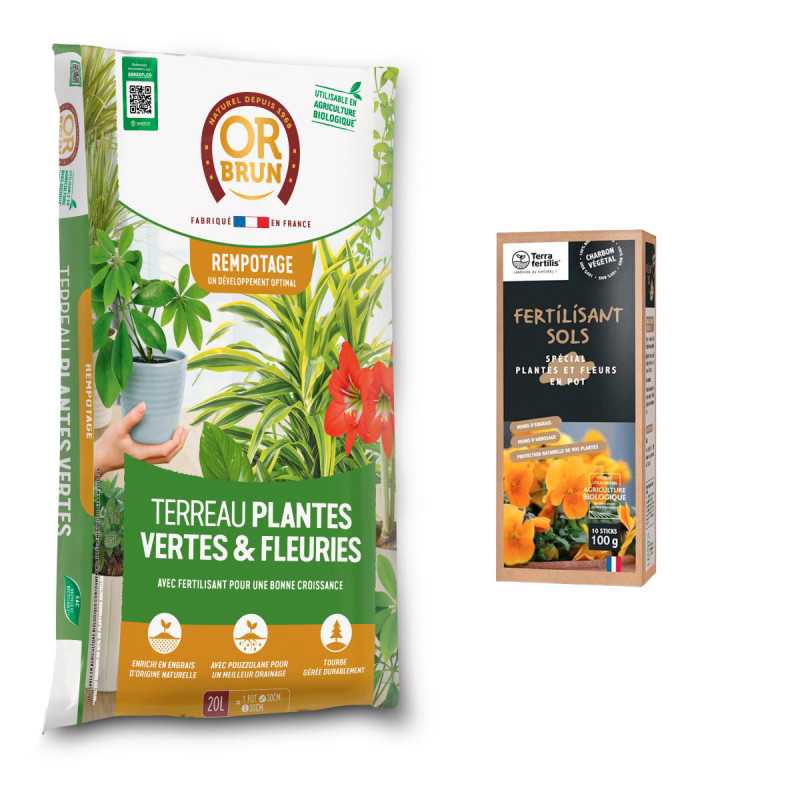
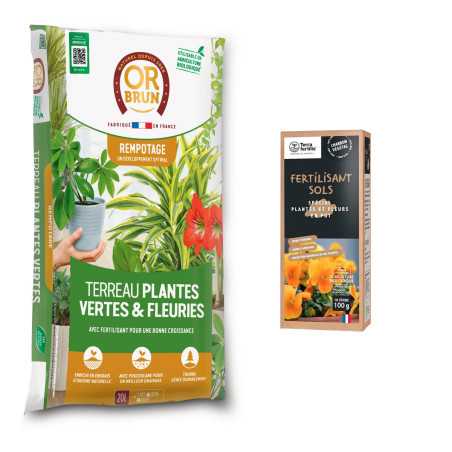
Repotting a plant means giving it a new soil. But the soil in a pot does not regenerate by itself like that of a flower bed: it has no rain passing through it, no earthworms, no deep horizon to draw from. This repotting pack therefore combines two products that do not do the same job: a fresh growing medium, and an amendment that stays in the pot after repotting.
A potting soil provides organic matter, and that matter gets used up: the plant draws on it, the soil fauna breaks it down, the water carries off the rest. After a season, the medium has settled and grown poorer. Biochar, for its part, is not used up. Obtained by pyrolysis of plant material, it is a porous, chemically stable carbon skeleton: it does not degrade like an organic amendment, it stays in the pot, where it retains the water and nutrients that watering would wash away, and its microporous structure shelters the microbial life that the potting soil has brought.
That is why these two products go together, and not just any potting soil with any fertiliser: the first feeds, the second makes it last. On one side a potting soil usable in organic farming, on the other a fertiliser made up of 98 % plant charcoal with a neutral pH (6.5 to 7): nothing harsh goes into the pot, and nothing is lost from it.
The Or Brun Green & Flowering Plants Potting Soil is a substrate rich in organic matter, whose particle size lets water circulate without suffocating the roots. It is usable in organic farming. Twenty litres comfortably cover several indoor pots, or two to three balcony planters. For plants that fear excess water, a bed of clay balls at the bottom of the pot is still a good idea — it is not included in this pack.
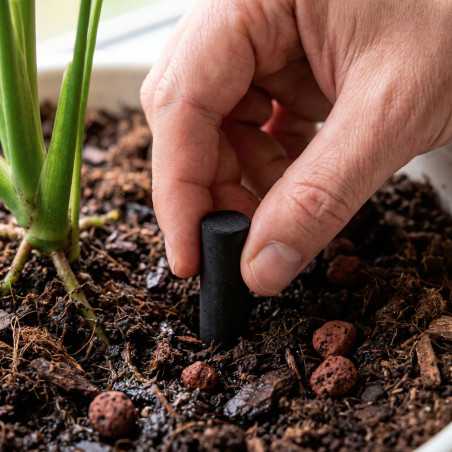
Biochar is a plant charcoal: a porous, stable material that does not break down in a few weeks like an organic fertiliser. Supplied here as 10 sticks of 10 g, it is pushed straight into the substrate, with no dosing or mixing. It is the simplest way to put biochar into a pot, and that is why it goes well with repotting: the sticks are placed in the fresh potting soil while the root ball is still accessible.
This porosity does all the work: according to the manufacturer's data from Terra Fertilis, it represents a specific surface area of 300 to 400 m²/g, allows watering to be spaced out by up to 40 % and fertiliser inputs to be reduced by about 30 %. In a pot, where every watering washes away part of the nutrients, that is precisely where it counts.
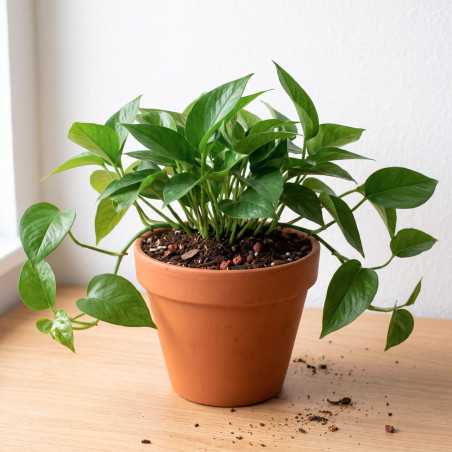
Take the plant out, gently tease apart the tangle of roots and remove the old substrate that comes away. Pour a first layer of potting soil into the bottom of the new pot, set the root ball in, then fill the gaps, pressing down lightly so as not to leave any air pocket. Before the final watering, push the sticks into the soil, halfway between the root ball and the edge of the pot. Finish with a generous watering, which brings the medium into contact with the roots and moistens the sticks.
| Contents | Details |
|---|---|
| Or Brun Green & Flowering Plants Potting Soil | 1 bag of 20 litres — ref. OBRTPV20N |
| Terra Fertilis biochar fertiliser | 1 box of 10 sticks of 10 g — ref. BIO108BR_BE |
| Use | Repotting green and flowering plants, indoors as well as outdoors |
| Parcel weight | 7.65 kg |
| Potting soil usable in organic farming | Yes |
| Specific surface area of the biochar | 300 to 400 m²/g (manufacturer data) |
| Pack reference | PACKPLVERTES |