IBC 1000 L accessories
 Heating jackets
 Fittings
 Drums, jerrycans & fittings
 Seeds





 Plant protection & biocides



 Garden


 Green spaces & municipal
 Barbecue, fire pit & fireplace
 Cleaning & care

 Refrigerants & air conditioning

 Watering

- New
World's Fastest Online Shopping Destination
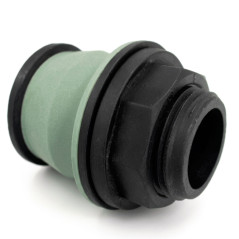
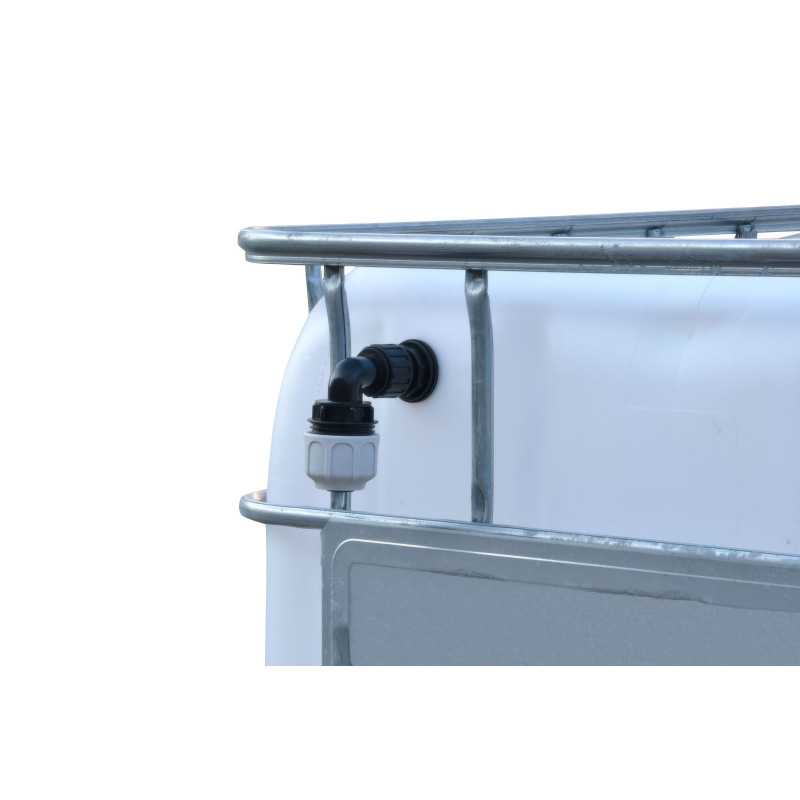
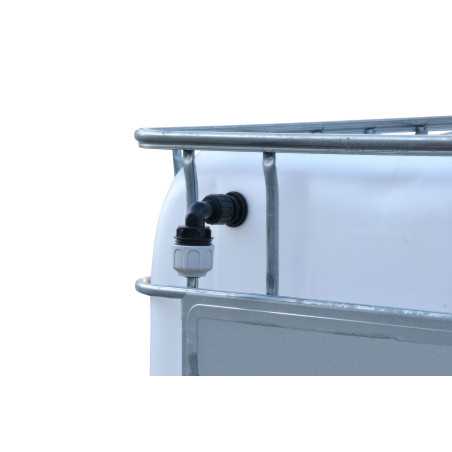
An overflow that is fitted without ever opening the tank. The Quick Joint bulkhead fitting goes on entirely from the outside : you drill, you push it through, you tighten the nut. Nothing to hold or screw on the inside, where nobody can reach on a 1,000-litre tank.
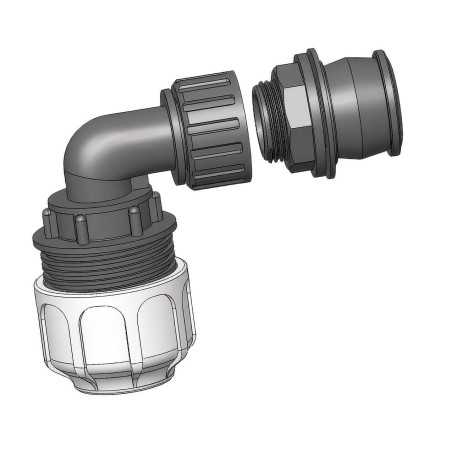
The 90° elbow turns downwards and the pipe is tightened by hand on a compression fitting. Two sizes : 25 and 32 mm.
 Safety guarantees100% secure payment
 Shipping PolicyResponsive and attentive after-sales service
 Returns PolicyFast and secure delivery
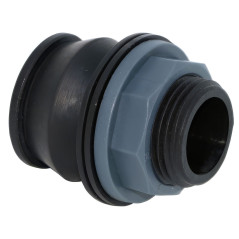
Create an overflow on an IBC tank without ever opening the tank. The Quick Joint bulkhead fitting goes on entirely from the outside : no counter-piece to hold inside, no arm to pass through the manhole. You drill at the height you want, you push it through, you tighten.
This is what sets this kit apart from all other overflows, and it is the whole point of the Quick Joint.
A conventional bulkhead fitting goes on in two parts : a body presented on one side of the wall, a nut screwed on from the other. On an IBC tank, that means passing your arm inside a 1,000-litre container through the manhole on top, blind, to hold a part while you tighten outside. When the tank is already in place, or has already held something, it is awkward at best and often impossible.
The Quick Joint removes that step. It has no inner counter-piece. You drill the wall, push the body through from the outside, tighten the nut — again from the outside — and it is fitted. You never touch the inside of the tank, and you can install the overflow on a tank that is already in service.
Holding and sealing are done by the same part : a self-adapting expanding EPDM seal.
When you tighten the nut, the seal is compressed along the axis of the fitting. Unable to lengthen any further, it expands radially and presses hard against the edge of the hole, on both sides of the wall. The tighter you go, the harder it presses. This bead is what locks the fitting mechanically and closes the way to the water.
Its variable geometry lets it fit just as well on a flat wall as on a curved one. This is no detail on an IBC tank : the side is bulged, and a conventional flat seal would only bear on two lines of contact.
Tighten by hand first, then finish with pliers or a drill-driver depending on access. Working pressure : 4 bar, far above what a 1.2-metre column of water exerts at the bottom of a tank.
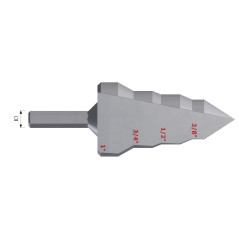
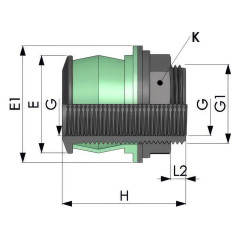
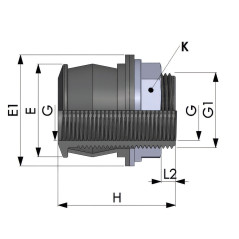
The diameter of the hole depends on the version chosen, and it is the only figure you need to have in mind before ordering.
| Version | Reference | Thread | Hole | Outlet |
| 25 mm | 0101671-25 | 1 inch (26/34) male | 43 mm | 25 mm |
| 32 mm | 0101671-32 | 1 1/4 inch (33/42) male | 52 mm | 32 mm |
A hole saw is enough. Drill at the height where you want the level to stop : you decide the usable volume of the tank, not an opening imposed by the container's manufacturer.
Choose an even area of wall, away from ribs and corners, and check that a bar of the metal frame does not run just behind it : you need to be able to push the body of the fitting through and work the nut.
A tank that collects rainwater ends up full. Without a connected overflow, the surplus comes out at the top and runs down the side : the ground is dug out at the foot of the pallet, the base is undermined, and the water goes where it should not — against a wall, onto a path, into a passageway.
Connecting the overflow deals with all three at once. The surplus leaves in a pipe and you choose where it goes : an inspection chamber, a ditch, a second tank, an infiltration area. The foot of the tank stays dry and stable.
The outlet is a 90° elbow pointing downwards. A straight fitting would send the pipe out horizontally, unsupported ; you would have to force it down at once, and it would pull on the fitting at the very spot where the seal matters. With the elbow, the pipe drops in line from the outlet and runs down the side with no effort.
The pipe is not pushed onto a barb that would then have to be locked with a clamp. It is tightened in a compression fitting with a union nut. It comes apart without tools when you winterise, and there is no screw to rust against the side of the tank.
Both versions are fitted the same way. What changes is the flow that can be discharged, the pipe to connect and the diameter to drill.
If in doubt, look at the pipe you already have, or the one on the network you are discharging into : it is the one that decides.
| Details | Specifications |
| References | 0101671-25 (25 mm version) and 0101671-32 (32 mm version) |
| Brand | Bucchi |
| Range | Line 1000 - The Innovations |
| Function | Create and connect an overflow on an IBC tank |
| Bulkhead fitting | Bucchi Quick Joint, fitted entirely from the outside |
| Bulkhead fitting seal | Self-adapting expanding EPDM |
| Walls accepted | Flat or curved |
| Working pressure | 4 bar |
| Outlet | 90° elbow pointing downwards, compression fitting |
| Sizes | 25 mm and 32 mm, your choice |
| Material | UV-stabilised polypropylene, EPDM seals |
| Use | Water |
Technical sheet
Specific references
| Tube diameter | 25mm 32mm |
| Combinations | Tube diameter | Reference | Supplier reference | Stock | Price | Add to cart |
Tube diameter : 25mm Reference : 0101671-25 | 25mm | 0101671-25 | 0101671.054K0000 | This product is no longer in stock | €17.00 TTC | |
Tube diameter : 32mm Reference : 0101671-32 | 32mm | 0101671-32 | 0101671.055N0000 | This product is no longer in stock | €24.00 TTC | |
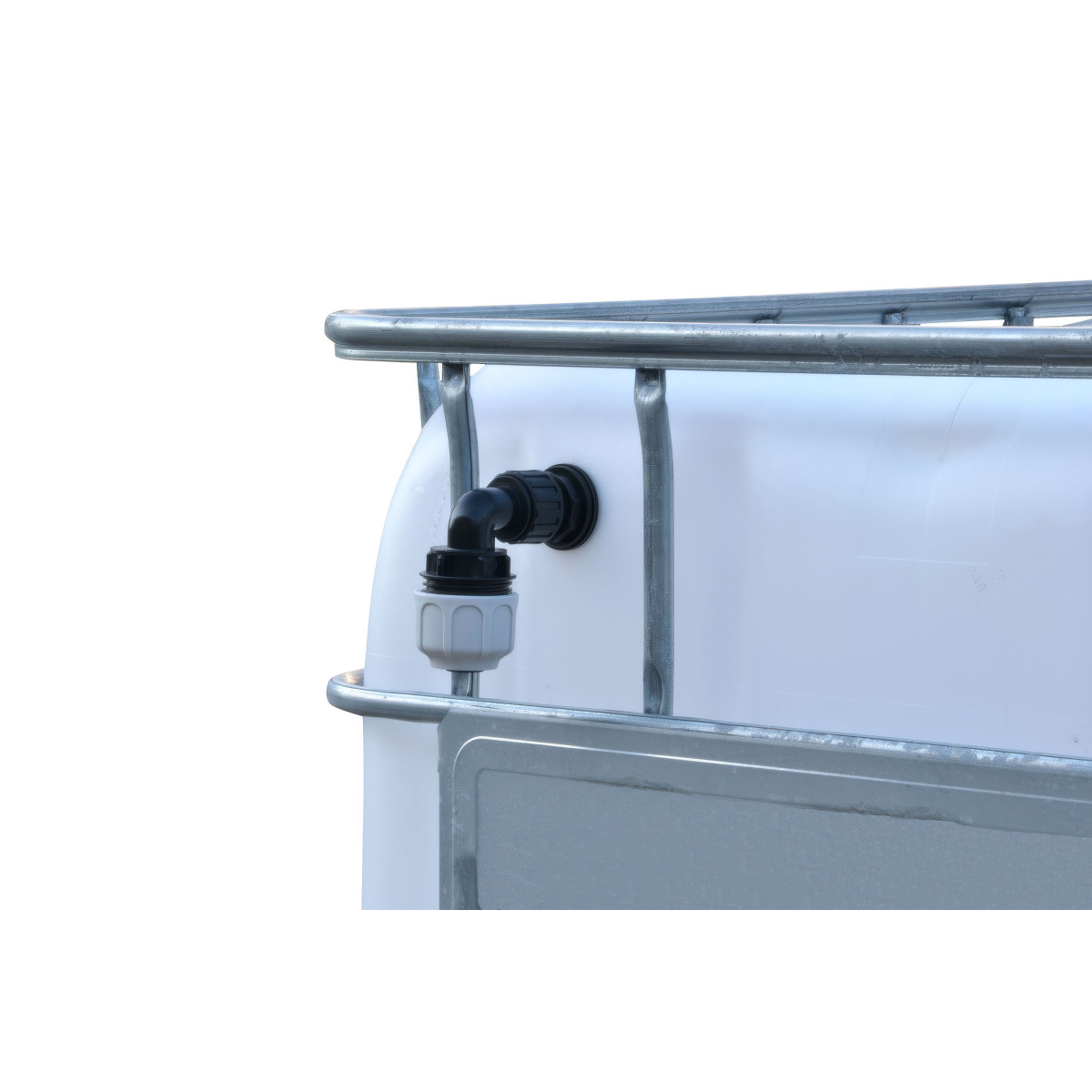
An overflow that is fitted without ever opening the tank. The Quick Joint bulkhead fitting goes on entirely from the outside : you drill, you push it through, you tighten the nut. Nothing to hold or screw on the inside, where nobody can reach on a 1,000-litre tank.
The 90° elbow turns downwards and the pipe is tightened by hand on a compression fitting. Two sizes : 25 and 32 mm.