IBC 1000 L accessories
 Heating jackets
 Fittings
 Drums, jerrycans & fittings
 Seeds


 Plant protection & biocides


 Garden



 Green spaces & municipal

 Barbecue, fire pit & fireplace
 Cleaning & care

 Refrigerants & air conditioning
 Watering
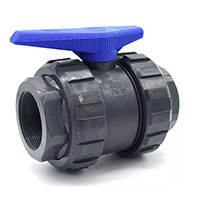
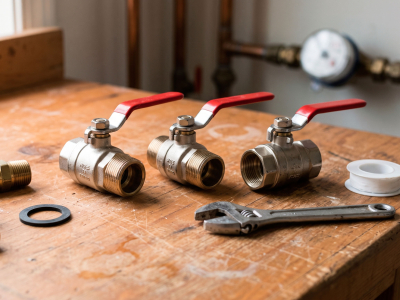
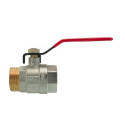
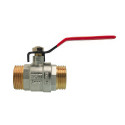
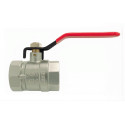
Brass ball valve: male-female, male-male or female-female, which one to choose?
One Saturday morning, you are replacing the valve that shuts off the water supply to the garage. It was twenty years old, it only turned with pliers, and it had been weeping since last winter. You unscrew it, you buy a new one, and that is when the question comes up: the valve has a male thread on one side and a female on the other, or two males, or two females. Which one do you actually need? It is the right question, and the one people ask too late, at the counter, with the old part in their hand.
🔧 WHY A BRASS BALL VALVE
The principle is simple: a drilled ball turns inside the valve body. With the handle in line with the pipe, water flows; with the handle across it, the ball blocks the way. A quarter turn is enough, you can see at a glance whether it is open or closed, and there is no screw thread that seizes up over the years like on an old globe valve. It is also called a ball valve or, in everyday searches, a tap with a ball.
Brass does the rest: it is the classic material for plumbing fittings and handles hot water as well as cold. The three valves we are discussing here, brass valves from the Ezfitt Smart range, are made of forged brass, nickel-plated on the outer surfaces.
🛠️ WHAT MAKES THE DIFFERENCE IN THIS RANGE
On paper, all ball valves look alike. What differs are the details you only notice after ten years, or when you take one apart. Here is what the manufacturer states for these models.
The stem seal relies on two EPDM O-rings. The area around the stem is where a valve often ends up weeping as it ages: having two O-rings rather than one is extra insurance.
Even with the handle removed, mains pressure cannot push the stem out of the body. A detail that seems theoretical, until the day you remove a handle on a pipe under pressure.
Every valve is leak-tested at the factory before it ships. It is designed, manufactured and tested to the European standard EN 13828, the one for ball valves.
The flat red handle is reversible and shows the direction of operation: no more hesitation in front of a valve nobody has touched for two years. A data matrix on the handle and the label links to the technical sheets from a smartphone.
The manufacturing date, the nominal pressure (PN), the size and the ACS marking are printed on the valve. When you need to check a part fitted a long time ago, everything is on the body.
The stated temperature range covers the cold water of a garden supply as well as the hot water of a domestic circuit. One reference for both uses, without wondering which goes where.
One last detail that matters when fitting: the threads are BSPP gas threads (parallel, according to ISO 228-1) and the faces are flat. The manufacturer therefore provides for sealing with a flat gasket, which we come back to below.
↔️ MALE-FEMALE, MALE-MALE OR FEMALE-FEMALE: WHICH ONE FOR YOUR INSTALLATION?
The rule is the same for all three: a female end screws onto a part with a male thread, and a male end screws into a part with a female thread. So to choose, do not look at the valve, look at what surrounds it: what you have on both sides of the spot.
| Configuration | Choose it when you connect | Sizes on the sheet |
|---|---|---|
| Male-female valve | A part with a male thread on one side and a part with a female thread on the other: the most common case on an existing pipe | Seven sizes, from 3/8 to 2 inch |
| Male-male valve | Two parts with a female thread, for example two sockets, or a socket and a female outlet fitting | Four sizes, from 3/8 to 1 inch |
| Female-female valve | Two parts with a male thread, for example two nipples, or a threaded pipe and a male end fitting | Ten sizes, from 3/8 to 4 inch |
Each of the three sheets groups all the sizes: you choose the diameter directly on the product page, without looking for a separate reference per size. If the distance between your two parts does not come out right, an equal brass nipple or a male-female reduction will sort it out. The whole range of connecting parts is in the category screw-on brass fittings.
Not sure about the thread itself, 15/21, 20/27, 26/34? Our plumbing thread chart gives the correspondence between inches, millimetres and trade designations. Measure the outside diameter of a male thread, or the inside diameter of a female one, and check the chart: it is five minutes of work that saves a return trip.
📏 THE NOMINAL PRESSURE DEPENDS ON THE SIZE
A valve does not have a single nominal pressure. The PN figure, engraved on the body, drops as the diameter increases. Here is what the manufacturer gives for the range.
| Sizes | Nominal pressure | Applies to |
|---|---|---|
| 3/8, 1/2, 3/4 and 1 inch | PN 32 | All three configurations |
| 1 1/4 inch, 1 1/2 inch and 2 inch | PN 25 | Male-female and female-female |
| 2 1/2 inch, 3 and 4 inch | PN 16 | Female-female only |
These values comfortably cover a domestic water network. The distinction only matters on a high-pressure installation, a technical room or a boiler room: then check the PN for the size you order, it is shown on the sheet and marked on the valve.
🧰 FITTING: WHAT TO PLAN FOR WITH THE VALVE
The faces of these valves are flat: sealing is done by compressing a flat gasket between the valve and the neighbouring part, as the manufacturer specifies. A new valve and a forgotten flat gasket is the start of a leak. So slip a flat gasket onto each connection; the category gaskets offers them in several materials and sizes.
For the other threaded fittings in your installation, PTFE tape remains a workshop classic. All the sealing solutions are gathered in the category sealing. If in doubt about a particular installation, better to write to us than to force a thread.
🏠 WHERE TO FIT THESE VALVES: PRACTICAL CASES
The water supply of the house. A new, easy-to-operate valve on the supply is the job everyone puts off and regrets on the night of a leak. Depending on what you have on each side of the spot, it will be one of the three configurations: the selector below helps you decide.
Each wet room. On the branch to the bathroom, kitchen or utility room, a valve lets you shut off a single circuit without cutting off the whole house. It is what craftsmen who work properly do: a valve at every branch.
The water heater and the technical room. The stated temperature range allows them to be fitted on the hot side as well as the cold side. To organise a room with several valves and unions, our guide fittings, unions and valves for the technical room shows typical set-ups.
The garden and winterising. A valve at the head of the watering circuit avoids shutting off the whole house in autumn. And before the first frosts, you close it and drain the outdoor section: our advice on protecting valves and fittings from frost explains the method.
And for an IBC tank? It is not the same family: 1000-litre tanks have their own threads and their own valves, detailed in our guide how to choose a valve for your IBC tank. The valves in this article are made for plumbing with gas threads.
Multitanks Expert Tip
Stick a label near each main valve: “garage water”, “bathroom”, “garden”. In an emergency, nobody looks properly, and you close the wrong one. It is five minutes with a felt pen on a piece of tape, and it avoids a flood at the worst moment.
🔎 Which valve for my installation?
Tell us what you are connecting on each side
Share this content